Managing content delivery for a growing SaaS platform or a company with numerous web properties can quickly become complex. With the rise of multi-tenant architectures, companies need a scalable, secure, and efficient way to manage websites across various domains—while also maintaining consistent performance, security, and reliability.
What is Amazon CloudFront SaaS Manager?
CloudFront SaaS Manager builds on Amazon CloudFront's proven capabilities—high-speed content delivery, TLS termination, DDoS protection, and customizable caching—and introduces a template-based approach for managing multi-tenant environments at scale.
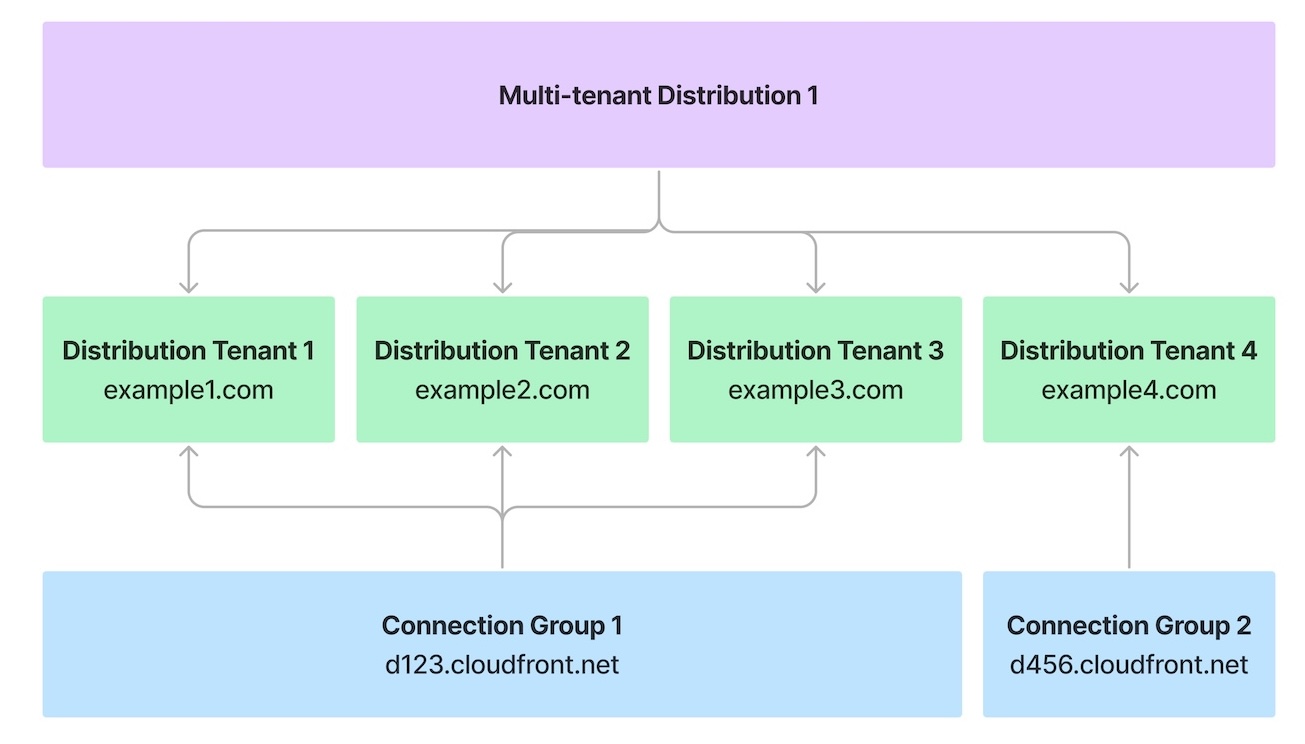
With the Multi-Tenant Distribution model, a single CloudFront distribution can serve content for multiple tenants (customers, websites, or brands), all while sharing a common configuration. This eliminates the need to create and manage individual CloudFront distributions for each domain, reducing operational overhead significantly.
Key Concepts: Template Distributions and Distribution Tenants
Here's how it works:
- Template Distribution: This acts as a reusable blueprint that includes common configurations such as origin settings, cache behaviors, and security policies.
- Distribution Tenants: These represent specific tenants or customers. Each tenant can define its own domain, origin path, and even override inherited settings like TLS certificates and WAF rules.
This model is ideal for platforms that serve multiple client websites—each with unique domains—but want to streamline delivery using shared infrastructure.
A Real-World Example: MyStore SaaS Platform
Let's imagine a fictional e-commerce platform called MyStore, which helps customers launch and manage their own online stores. MyStore organizes its customers into Bronze, Silver, and Gold tiers based on service levels and performance requirements.
Each customer receives a persistent subdomain like customer.mystore.app. With CloudFront SaaS Manager, MyStore can:
- Create a Bronze-tier template distribution for basic services
- Set up a Silver-tier with enhanced caching or regional delivery
- Offer Gold-tier customers advanced security like AWS WAF, custom TLS certificates, and dedicated connection groups
Each customer (or tenant) is then mapped to their respective tier. For example:
- bronze.hardikshah.cloud → Bronze Tier
- silver.hardikshah.cloud → Silver Tier
- gold.hardikshah.cloud → Gold Tier
This structure provides flexibility, isolation, and consistent performance across all tenants.
Step-by-Step: Setting Up a Multi-Tenant Distribution
- Create a Multi-Tenant Template
Choose the origin type (e.g., an Amazon S3 bucket), define caching and security settings, and assign it to a specific tier like Bronze, Silver, or Gold.
- Add Distribution Tenants
Each tenant gets its own domain and can override certain settings if needed (e.g., specifying a custom TLS certificate or WAF configuration).
- Manage Connection Groups (Optional)
By default, all CloudFront traffic is routed through a single connection group. For premium tiers, you can create additional connection groups to isolate traffic and improve control over routing behavior.
Benefits of Using CloudFront SaaS Manager
- Operational Simplicity: Manage hundreds or thousands of customer websites with fewer configurations.
- Improved Security: Apply baseline or tenant-specific WAF rules and TLS certificates.
- Performance Optimization: Maintain low latency delivery across all domains using Amazon's edge network.
- Scalability: Easily onboard new tenants without provisioning new distributions.
Ready to Get Started?
We encourage you to explore CloudFront SaaS Manager to simplify your multi-tenant architecture. Here are a couple of resources to help you dive deeper:
Final Thoughts
CloudFront SaaS Manager provides a scalable and efficient foundation for SaaS platforms and multi-brand companies to deliver content globally—with security and performance built in. Whether you serve 10 tenants or 10,000, this feature will help you simplify operations and focus on building great customer experiences.