Beyond Zonal Silos: Why AWS Regional NAT Gateway is a Massive Win for Architects

Hardik Shah
Cloud Architect & AWS Expert
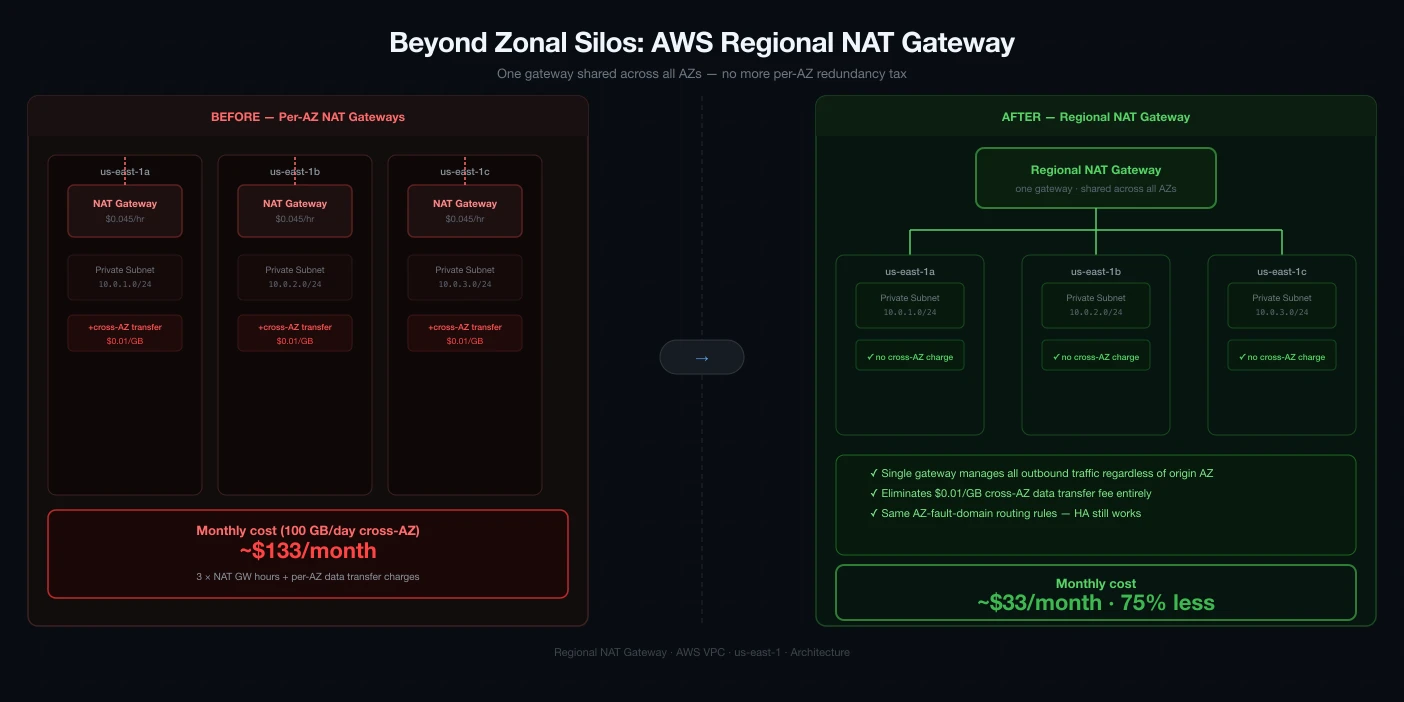
If you have been architecting on AWS for a while, you know the drill. You want high availability, so you spread your workloads across multiple Availability Zones. But to let those private resources talk to the internet, you have to deploy a NAT Gateway in each AZ. That means public subnets, elastic IPs, and route tables for every single zone. It's a lot of boilerplate infrastructure.
The Old Way: Zonal Silos and Complexity
Traditionally, AWS NAT Gateways are zonal resources. They live in a specific Availability Zone. To ensure that an AZ failure doesn't take down your entire internet egress, AWS best practices dictate that you create a NAT Gateway in *each* AZ you use.
This approach works, but it comes with a high maintenance cost. Every time you expand your architecture to a new AZ, you have to:
- Create a public subnet in that AZ.
- Deploy a NAT Gateway in that public subnet.
- Update the route tables of your private subnets to point to that specific NAT Gateway.
It's repetitive, prone to human error (or at least Terraform copy-paste fatigue), and requires you to maintain public subnets even in VPCs that you want to keep strictly private.
Enter the Regional NAT Gateway
AWS recently announced a feature that simplifies this significantly: **Regional NAT Gateway**. Instead of being bound to a single AZ, a Regional NAT Gateway operates at the VPC level.
This is a fundamental shift in how we handle VPC egress. Here is why it is a massive win for cloud architects:
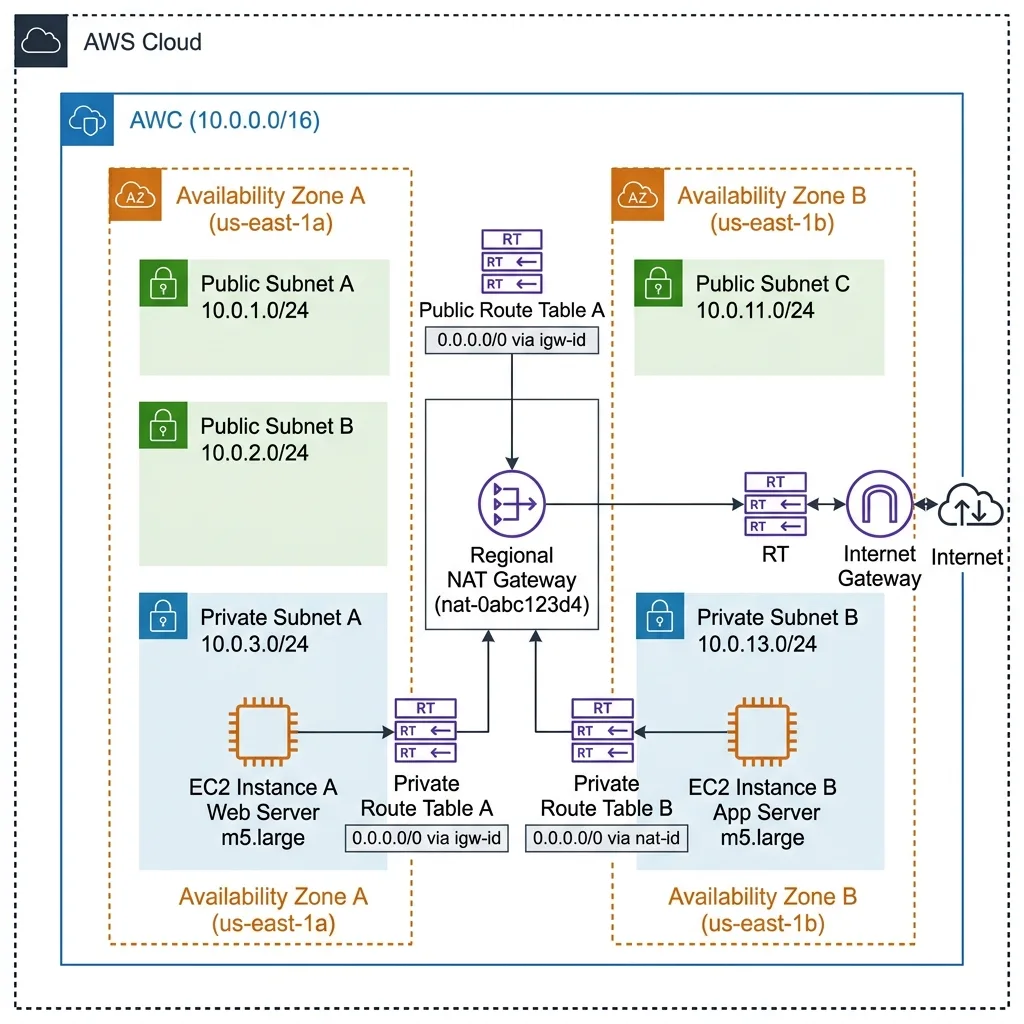
Figure 1: Traditional Zonal NAT vs. the new Regional NAT Gateway architecture.
1. Operational Simplicity
With Regional NAT Gateway, you don't need to deploy a NAT Gateway per AZ anymore. You create one Regional NAT Gateway for your VPC, and it automatically expands and contracts across AZs based on your workload presence. You can reuse the same route table and the same Regional NAT Gateway ID across all your subnets. No more zone-specific routing boilerplate.
2. The Death of the Public Subnet (in Private VPCs)
This is probably my favorite part. For security-conscious environments, the rule is simple: minimize the attack surface. Traditionally, to use a NAT Gateway, you *had* to have a public subnet to host it. This meant there was always a risk of someone accidentally launching a resource into that public subnet and exposing it to the internet.
With Regional NAT Gateways, you no longer need a public subnet in the VPCs that host your sensitive workloads. You can have a 100% private VPC and still get managed NAT egress.
3. Built-in Protection Against Port Exhaustion
If you've ever run high-scale workloads behind a NAT Gateway, you've probably feared SNAT port exhaustion. Traditionally, you had to monitor metrics and manually add secondary IPs to your NAT Gateway when connections got high.
The Regional NAT Gateway fixes this by automatically associating additional IP addresses when it requires more ports (up to 32 IPs per AZ). It scales up aggressively and scales down conservatively, keeping your workloads safe without manual intervention.
Architectural Considerations
While this is a fantastic update, there are a few things to keep in mind as an architect:
- **Cross-AZ Charges**: If you don't enable the Regional NAT Gateway in an AZ where you have workloads, traffic will be routed to an AZ where it *is* enabled, incurring cross-AZ data transfer charges. Make sure to enable it in all active zones.
- **Manual vs. Automatic**: AWS offers an "Automatic" mode where it handles IPs for you (great for most) and a "Manual" mode if you need to strictly control or allowlist specific Elastic IPs.
Zonal vs. Regional NAT Gateway
| Feature | Zonal NAT Gateway | Regional NAT Gateway |
|---|---|---|
| Scope | Tethered to a single AZ | VPC-level (cross-AZ by design) |
| Public Subnets | Required in every AZ with workloads | Not required in every AZ |
| Port Exhaustion | Manual remediation required | Automatic scaling of IP addresses |
| Management Overhead | High (Manage per-AZ resources) | Low (Manage single logical resource) |
| Pricing Benefit | Pay per NAT Gateway instance | Potential cost reduction by needing fewer instances |
Conclusion
The Regional NAT Gateway is one of those features that makes you wonder why it wasn't there from day one. It removes operational toil, improves security by eliminating unnecessary public subnets, and solves scaling issues automatically.
For any new VPC you build, this should likely be your default choice for internet egress. For existing environments, it's definitely worth looking into the refactor to simplify your networking stack.
About Hardik Shah
Hardik designs VPCs for a living and has drawn the per-AZ NAT Gateway trio on more architecture diagrams than he can count. He writes about AWS networking changes in terms of what they do to those diagrams and to the bill.